A Better Way to Practice Tai Chi
Here is a list of Tai Chi movements and postures, with accompanying video demonstrations.
Jump to:
Steelyard 27 Form
Recommended completion time: ~3 minutes, 20 seconds.
| # | English Name | Pinyin (中文) |
| 1 | Preparation | Yùbèi (预备) |
| 2 | Beginning | Qǐ shì (起式) |
| 3 | Grasp the Bird’s Tail | Lǎn què wěi (揽雀尾) |
| 4 | Single Whip | Dān biān (单鞭) |
| Omit section of long form | ||
| 5 | Cloud Hands (3 times) | Yún shǒu (云手) |
| 6 | Single Whip | Dān biān (单鞭) |
| 7 | High Pat on Horse | Gāo tàn mǎ (高探马) |
| 8 | Right Separation Kick | Yòu fēn jiǎo (右分脚) |
| 9 | Left Separation Kick | Zuǒ fèn jiǎo (左分脚) |
| 10 | Turn Body and Kick with Heel | Zhuǎn shēn zuǒ dēng jiǎo (转身左蹬脚) |
| 11 | Brush Knee and Push (2 times) | Lōu xī ǎo bù (搂膝拗步) |
| 12 | Step Forward and Punch Down | Jìn bù zāi chuí (进步栽锤) |
| 13 | Turn Body, Chop with Fist | Zhuǎn shēn piē shēn chuí (转身撇身锤) |
| 14 | Step Forward, Parry, Block, and Punch | Jìn bù bān lán chuí (进步搬拦锤) |
| 15 | Right Heel Kick | Yòu dēng jiǎo (右蹬脚) |
| 16 | Left Strike Tiger | Zuǒ dǎ hǔ shì (左打虎式) |
| 17 | Right Strike Tiger | Yòu dǎ hǔ shì (右打虎式) |
| Omit section of long form | ||
| 18 | Single Whip | Dān biān (单鞭) |
| 19 | Snake Creeps Down | Xià shì (下势) |
| 20 | Step Forward, Seven Stars | Shàng bù qī xīng (上步七星) |
| 21 | Step Back, Ride the Tiger | Tuì bù kuà hǔ (退步跨虎) |
| 22 | Turn Body, Lotus Kick | Zhuǎn shēn bǎi lián (转身摆莲) |
| 23 | Bend Bow, Shoot Tiger | Wān gōng shè hǔ (弯弓射虎) |
| 24 | Step Forward, Parry, Block, and Punch | Jìn bù bān lán chuí (进步搬拦锤) |
| 25 | Apparent Closing | Rú fēng shì bì (如封似闭) |
| 26 | Cross Hands | Shí zì shǒu (十字手) |
| 27 | Closing Posture | Shōu shì, Huán yuán (收式 还原) |
Steelyard 27 Form Video
Steelyard 27 Demonstration on World Tai Chi and Qigong Day
Steelyard 27 Demonstration on World Tai Chi and Qigong Day
Steelyard 34 Form
Recommended completion time: ~5 minutes, 20 seconds.
| # | English Name | Pinyin (中文) |
| 1 | Preparation | Yùbèi (预备) |
| 2 | Beginning | Qǐ shì (起式) |
| 3 | Grasp the Bird’s Tail | Lǎn què wěi (揽雀尾) |
| 4 | Single Whip | Dān biān (单鞭) |
| Omit section of long form | ||
| 5 | Cloud Hands (3 times) | Yún shǒu (云手) |
| 6 | Single Whip | Dān biān (单鞭) |
| 7 | High Pat on Horse | Gāo tàn mǎ (高探马) |
| 8 | Right Separation Kick | Yòu fēn jiǎo (右分脚) |
| 9 | Left Separation Kick | Zuǒ fèn jiǎo (左分脚) |
| 10 | Turn Body and Kick with Heel | Zhuǎn shēn zuǒ dēng jiǎo (转身左蹬脚) |
| 11 | Brush Knee and Push (2 times) | Lōu xī ǎo bù (搂膝拗步) |
| 12 | Step Forward and Punch Down | Jìn bù zāi chuí (进步栽锤) |
| 13 | Turn Body, Chop with Fist | Zhuǎn shēn piē shēn chuí (转身撇身锤) |
| 14 | Step Forward, Parry, Block, and Punch | Jìn bù bān lán chuí (进步搬拦锤) |
| 15 | Right Heel Kick | Yòu dēng jiǎo (右蹬脚) |
| 16 | Left Strike Tiger | Zuǒ dǎ hǔ shì (左打虎式) |
| 17 | Right Strike Tiger | Yòu dǎ hǔ shì (右打虎式) |
| 18 | Turn Body, Right Heel Kick | Huí shēn yòu dēng jiǎo (回身右蹬脚) |
| 19 | Twin Fists Strike Ears | Shuāng fēng guàn ěr (双峰灌耳) |
| Omit section of long form | ||
| 20 | Part the Wild Horse’s Mane (3 times) | Yě mǎ fēn zōng (野马分鬃) |
| 21 | Grasp the Bird’s Tail | Lǎn què wěi (揽雀尾) |
| 22 | Single Whip | Dān biān (单鞭) |
| 23 | Fair Lady Works at Shuttles | Yù nǚ chuān suō (玉女穿梭) |
| 24 | Grasp the Bird’s Tail | Lǎn què wěi (揽雀尾) |
| 25 | Single Whip | Dān biān (单鞭) |
| Jump forward | ||
| 26 | Snake Creeps Down | Xià shì (下势) |
| 27 | Step Forward, Seven Stars | Shàng bù qī xīng (上步七星) |
| 28 | Step Back, Ride the Tiger | Tuì bù kuà hǔ (退步跨虎) |
| 29 | Turn Body, Lotus Kick | Zhuǎn shēn bǎi lián (转身摆莲) |
| 30 | Bend Bow, Shoot Tiger | Wān gōng shè hǔ (弯弓射虎) |
| 31 | Step Forward, Parry, Block, and Punch | Jìn bù bān lán chuí (进步搬拦锤) |
| 32 | Apparent Closing | Rú fēng shì bì (如封似闭) |
| 33 | Cross Hands | Shí zì shǒu (十字手) |
| 34 | Closing Posture | Shōu shì, Huán yuán (收式 还原) |
A Brief History of Short Tai Chi Forms
There are dozens of unique Tai Chi styles and forms practiced in the world today. This outline shows why Steelyard Tai Chi forms are the superior choice.
From 108 to 24 Postures
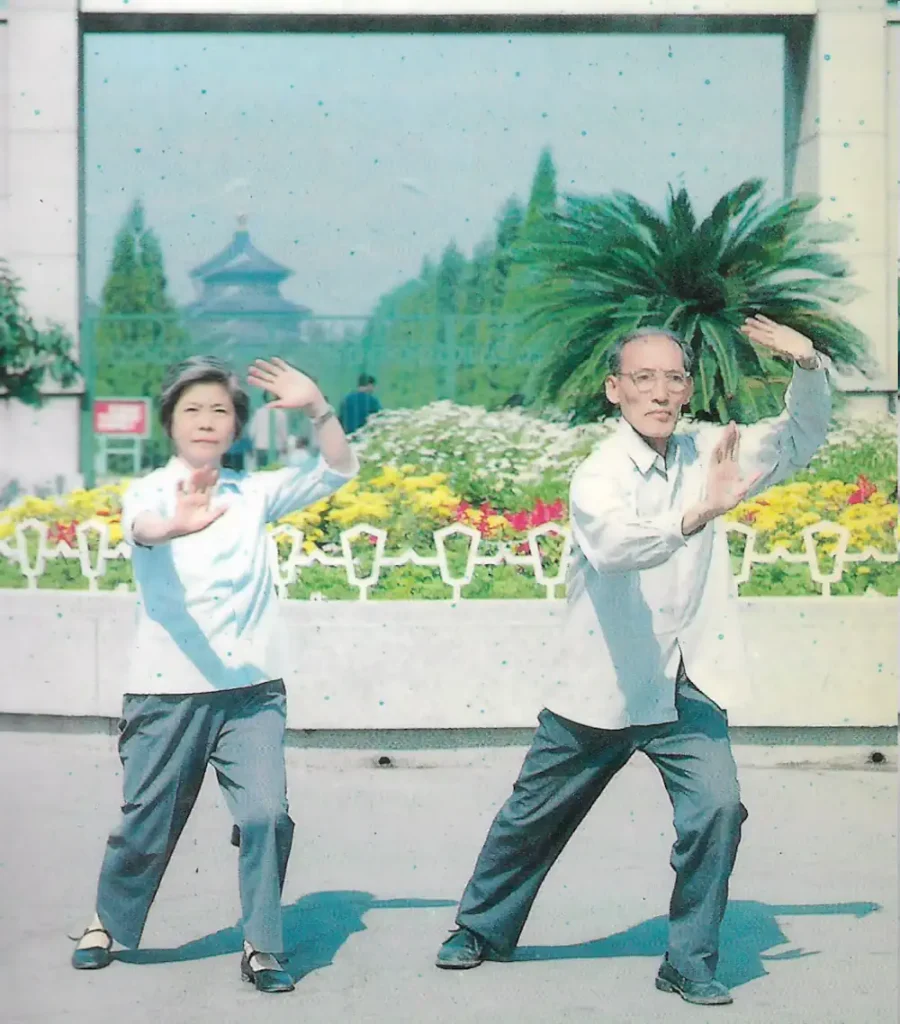
1952 marked the one hundred year anniversary of Yang family Tai Chi. It had been one century since Yang Luchan first demonstrated his art in the private halls of upper-class Beijing. It had been four decades since his grandson, Yang Chengfu, first began offering it for public tuition.
In the mid-1950s, Tai Chi expert Li Tianji began to speak publicly on the downfall of this once-esteemed art. Other Chinese martial arts leaders, such as Wang Xiangzhai, were making similar observations.
Tai Chi forms were extremely difficult to learn. Although a handful of teachers had attempted to reduce the complexity, their haphazard changes only seemed make the situation worse. These random alterations were diminishing the legacy of Taijiquan, and destroying its future potential.
At the request of the Chinese National Sports Commission, Li Tianji distilled a new Tai Chi routine.1 The 85 postures of the traditional Yang hand form were reduced to just 24. This essential sequence was designed for completion in five minutes, rather than twenty.
24 Simplified Forms quickly became China’s predominant style of Tai Chi practice. Within a decade, millions of people were performing it daily, in public parks and gymnasiums, schools and homes. The new 24 Form helped spread Taijiquan across the nation, and around the world.
Simplified Tai Chi appeared to be a resounding success. Yet Li Tianji, the man who had literally written the book on this project, would eventually declare it a bitter failure.2
24 Forms had not been guarded as a distillation of traditional wushu knowledge. Nor was it leveraged as an introduction to more advanced study. Instead, the Form had deviated further still, to adopt the effete aesthetics of a theater performance, and the social goals of a Maoist loyalty dance.
Jiu zi jiu yang. 九子九样. Tai Chi had been smothered nearly to death, under the weight of political assimilation, reckless innovation, and its own runaway fame. The old dragons had many sons, but no successors.
1 “越南教授胡志明主席太极拳记— 顾留馨” (My Memories of Teaching President Ho Chi Minh Taijiquan in Vietnam) by Gu Liuxin. Translated by Adrian Chan-Wyles, PhD.
2 “你们毁了我的太极拳” (They Have Ruined My Taijiquan) by Niu Shengxian.
The Complexity of Simplification
Students who learn the 24 Simplified Form, as a means of attaining the traditional benefits, forms, and achievements of Tai Chi, will face needless challenges. These obstacles include alterations to the names, shapes and character of postures, and changes to the footwork and transitional movements.
The 24 Form is not just a shorter and simpler version of its predecessor. It is meaningfully, confusingly different.
Furthermore, the simplified form does not address the sword, saber, push hands, drills and combat applications which comprise the bulk of a traditional curriculum.
To learn the 24 Form in isolation (as most students do), is to receive a partial, haphazard and contradictory education in Tai Chi Chuan.
24 Forms and Modern Fitness
24 Forms Taijiquan does not fare well in comparison to modern wellness disciplines. These include Hatha Yoga, Pilates, and CrossFit.
This Simplified Form is still too complex to be marketed as a simple relaxation practice, and too easy for a workout routine. Its challenges are somewhat arbitrary, and its achievements too meager. Young people are not interested in learning it, and the elderly are challenged to remember it all.
Newer, ultra-simplified Tai Chi and Qigong forms contain just 4 to 8 postures. Although they are easier to memorize, they otherwise exhibit the same fundamental shortcomings as the 24.
Why 27 is Greater Than 24
The Steelyard Tai Chi℠ Short Forms are short but potent routines, meant for students who have already grasped the traditional form of Tai Chi Chuan, or who are in the process of learning it.
The Steelyard Tai Chi Forms advance Li Tianji’s original goals. They make the art more accessible, while also preserving its depth and heritage. They place clear new milestones directly alongside the original path.
Steelyard Tai Chi forms are easier to learn, because there is no change to the order or shape of the traditional postures. There are no changes in the footwork or the transitional movements. They omit some postures and repetitions, without compromising the essence of the art.
Steelyard Forms are ideal for competition and exhibition. They are shorter in duration, and require a smaller performance area than the older traditional forms.
If you previously learned the traditional long form of Tai Chi (e.g. Yang 85/103/108), then you have already learned these forms too! You only need to omit a few sections; and to execute the remaining movements slightly faster than normal practice speed.
